
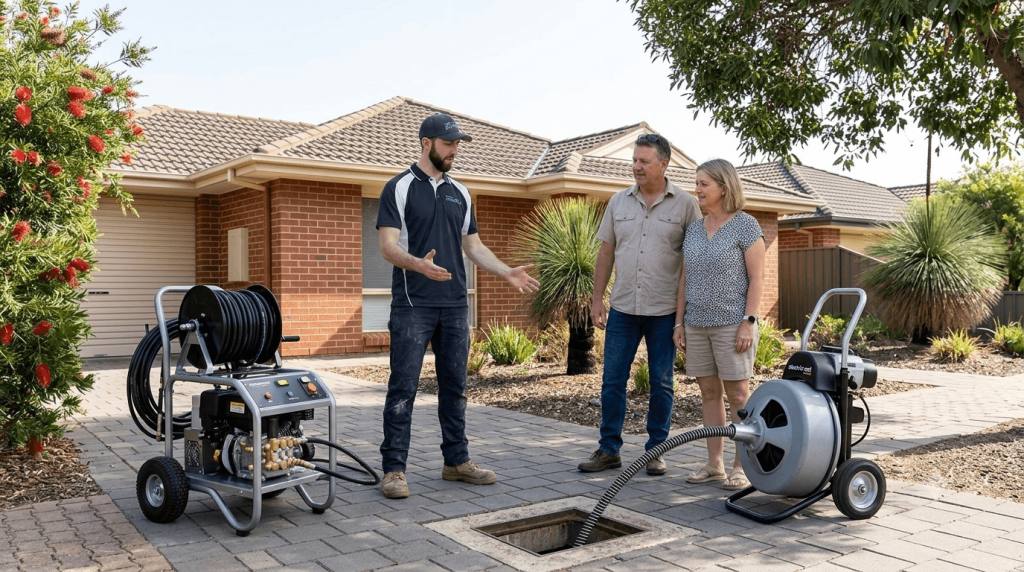
Key Takeaways
- If it’s a small, annoying clog (think hair, food bits, or roots just starting to creep in), an electric eel will usually sort it out.
- For the big, stubborn stuff like grease buildup or full blockages, hydro jetting is the way to go, and a lot of that comes down to Adelaide’s clay soil moving pipes around underground.
- Got an older home with terracotta or clay pipes? You’ll want to be a bit careful, because jetting at the wrong pressure can do more harm than good.
- Those big old gum trees and jacarandas around Unley, Norwood, and Burnside are notorious for sending roots into pipes, and hydro jetting is usually what’s needed to clear them properly.
- Honestly, getting a CCTV inspection done first can save you a fair bit of money and stop you calling a plumber out again next month for the same problem.
So Why Do Adelaide Drains Block Up So Often Anyway?
If you’ve lived in Adelaide for a while, you’ve probably noticed that blocked drains in Adelaide seem to be… a thing here. Like, more than you’d expect. And it’s not just bad luck or you flushing something you shouldn’t have (though, yeah, that happens too).
A big part of it comes down to our soil. Adelaide has a lot of reactive clay soil, which is basically soil that swells up when it rains and then shrinks back down when things dry out. Over years and years, that constant swelling and shrinking shifts the pipes under your yard, ever so slightly. Just enough to create tiny gaps or cracks at the joints.
And guess what loves finding those gaps? Tree roots. If you’re in one of those leafy older suburbs like Unley, Burnside, North Adelaide, or Walkerville, with those gorgeous big established trees, there’s a good chance the roots from those trees have found their way into your sewer line at some point. Once they’re in, they don’t just sit there politely. They spread out into thick root balls that catch everything else flowing through, paper, grease, you name it, until eventually nothing’s getting through at all.
Then there’s the age of a lot of Adelaide housing. So many homes here, especially the character ones built before the 1970s, still have their original terracotta pipes. They’re charming houses, but those old pipes are pretty brittle. When we get a dry spell followed by a sudden downpour (which, let’s be honest, is very Adelaide weather), the ground shifts quickly and those old pipes can crack.
And then there’s the everyday stuff. Grease going down the kitchen sink, especially in older homes where the pipes are narrower than what’s used now. Add in wet wipes and other “flushable” products that really aren’t flushable at all, and you’ve got a recipe for a properly stubborn blockage.
The Electric Eel: Your Go-To for Smaller Jobs
Okay, so what actually is an electric eel? Basically it’s a long, flexible metal cable with a cutting or hooking tip on the end. A plumber feeds it down your pipe and it spins around, breaking up or hooking onto whatever’s causing the blockage.
This is the right tool when you’re dealing with:
- Hair clogs in the bathroom (a classic)
- Food scraps that have built up in the kitchen drain
- Early stage root growth, where it’s only just started poking through
- A blockage that’s pretty close to an access point
One thing we really like about the eel is that it’s gentle. If you’ve got those older terracotta pipes we mentioned earlier, an eel is usually the safer first option because it’s not putting a heap of pressure on the pipe walls.
But here’s the honest bit. An eel often just punches a hole through whatever’s blocking the pipe rather than actually cleaning it out. So if the real cause is a root mat or years of grease coating the inside of the pipe, you might get your drain flowing again for a few weeks, only for it to slow right back down again.
Hydro Jetting: The Heavy Hitter
Hydro jetting is a different beast altogether. Instead of a cable, it’s a hose that blasts water through your pipes at really high pressure, usually somewhere between 3000 and 4000 PSI. That pressure scours the entire inside of the pipe, not just one spot, stripping away grease, sludge, roots, and built up gunk along the whole length.
This is generally the better option when you’re dealing with:
- A full blockage caused by tree roots (very common in those older Adelaide suburbs)
- Years of grease buildup in kitchen or restaurant pipes
- A blockage that keeps coming back even after an eel has been used
- Stormwater drains clogged with leaves after Adelaide’s autumn drops everything at once
- Sewer lines that have a few different issues going on at the same time
The real win with hydro jetting is that it actually cleans the pipe, rather than just clearing a narrow tunnel through the blockage. So the problem is much less likely to come straight back.
The catch? Your pipes need to be in decent structural condition for jetting to be safe. If a pipe is already cracked or the joints are a bit loose, which isn’t unusual in older homes around North Adelaide or Prospect, blasting it with high pressure water could actually make things worse. This is exactly why we always recommend a CCTV inspection first, just so we know what we’re working with before we start.
What This Actually Looks Like Around Adelaide
Let’s make this a bit more real with some examples we see pretty often.
Picture a lovely old character home in Norwood, big jacaranda out the front, gorgeous in spring. But every few months, the toilet starts draining slowly. An eel clears it temporarily, but because the roots have already grown into the gap in the pipe, they just grow straight back. Hydro jetting combined with a root cutting tool gets the whole root mat out, not just a hole through the middle of it, which means it actually stays clear for much longer.
Or take a 1960s home in Prospect, original earthenware pipes still in the ground. The kitchen sink backs up regularly, and it turns out decades of grease has built up along the inside of the pipe, narrowing it bit by bit. An eel punches through the centre but leaves all that grease coating the walls. Hydro jetting at the right pressure strips that grease layer right off.
Then there’s a property up in the Adelaide Hills near Stirling, where after a heavy autumn downpour the stormwater drains are completely clogged with leaves and soil washed down from the garden. Hydro jetting is brilliant here because it can flush debris out over a long stretch of pipe, something an eel just isn’t designed to do.
So, Which One Do You Actually Need?
Honestly, it comes down to a few simple questions. How old are your pipes? What’s causing the blockage? And is this a one-off, or does it keep happening?
- First time dealing with a blockage and it seems minor? An eel is a reasonable place to start.
- Same problem popping up every few months? Hydro jetting deals with the actual cause instead of just band-aiding it.
- Got older terracotta pipes? Get a CCTV inspection done first so we know jetting won’t cause more issues than it solves.
If tree roots are giving you grief, our drain root removal service starts with a CCTV inspection so we can see exactly what’s going on before choosing the right method for your pipes. And if you’re dealing with a blocked drain Adelaide wide, especially one that just won’t stay fixed, it’s worth getting a proper blocked drain inspection done before anyone reaches for an eel or a jetter. Saves a lot of guesswork.
FAQs
1. How do I know if my blocked drain needs hydro jetting or an electric eel?
If it’s just a simple clog, hair, food scraps, that sort of thing, an eel should sort it out fine. But if it’s a recurring problem or it’s affecting more than one drain in the house, hydro jetting is going to give you a much better result because it cleans the whole pipe, not just a section of it.
2. Is hydro jetting safe for old pipes in Adelaide homes?
It depends on what kind of shape those pipes are in. If there’s already cracking or loose joints, high pressure water probably isn’t the best idea. That’s why we always suggest a CCTV inspection first, just to check everything’s solid enough to handle it.
3. Why do my drains keep blocking even after using a drain snake?
This happens a lot more than people realise. An eel tends to punch through the middle of a blockage and leave the buildup on the pipe walls behind. So any leftover grease, sludge, or bits of root are still sitting there, ready to cause the same problem again pretty quickly.
4. Can tree roots really break through underground pipes?
Yep, absolutely. Roots are constantly searching for moisture, and small cracks or gaps at pipe joints are exactly what they’re after. Once a root finds its way in, it keeps growing and eventually forms a dense mat that blocks water from getting through.
5. How often should hydro jetting be done for properties with mature trees?
It really depends on the property, but if you’ve had root issues before, jetting every 12 to 24 months as a preventative thing tends to work well. It depends a bit on how close the trees are and how old your pipes are.
6. Does hydro jetting work on stormwater drains as well as sewer lines?
It does, yeah. It’s actually really effective for clearing leaves, dirt, and general debris out of stormwater drains, which is super handy after a heavy rain event, especially if you’re up in the Hills.
7. Is a CCTV drain inspection necessary before clearing a blocked drain?
We’d say it’s definitely worth it, particularly if this isn’t the first time you’ve had this issue, or if your home is on the older side. It helps us see exactly what’s going on and where, so you’re not paying for unnecessary work or risking damage to your pipes.